If you stopped feeding garden birds during the summer, you’re probably wondering when it’s safe to start again. With changing advice, disease concerns and an extraordinary year of heatwaves and drought, the answer isn’t quite as simple as looking at the calendar.
So, when should I start feeding the birds again?
If you’ve followed the RSPB’s new seasonal feeding advice this year, you may have been counting down to October.
There’s just one problem: 1st October isn’t actually the date the RSPB currently recommends starting again.
Its latest guidance says to pause feeding seeds and peanuts from 1 May until 31st October, meaning full seed and peanut feeding can resume from 1st November. Mealworms, suet and fat products can still be offered in small quantities during the summer and autumn. The RSPB has also strengthened its advice around feeder hygiene, moving feeders and avoiding flat feeding surfaces.
So, if you’ve been waiting for November, you’ve been following the current guidance correctly.
But does that mean 1st November is a magical date when feeding suddenly becomes safe?
I’m not convinced nature works quite like that.
Why has bird feeding become so confusing?
For decades, millions of us have happily fed garden birds throughout the year. Then, suddenly, the advice changed.
The concern is trichomonosis, a disease caused by a microscopic parasite that particularly affects finches. It has been associated with a significant decline in Greenfinches and is also affecting other species. We have a detailed blog on the subject here.
There is a perfectly reasonable concern here. When birds gather around food, particularly in high numbers, there is greater opportunity for disease to spread.
I’ve seen trichomonosis in my own garden. I know how horrible it can be. A sick Greenfinch can look desperately unwell, struggling to swallow, puffed up and lethargic. So I don’t dismiss the disease risk.
What I question is whether a fixed seasonal withdrawal of food is always the best answer. Because there is another side to the equation.

Nature doesn’t follow the calendar
This summer has given us a pretty good demonstration of why I think we need some nuance.
2026 has been an extraordinary year for weather. We’ve experienced repeated heatwaves, exceptionally high temperatures and prolonged dry conditions. England had its driest July since records began, while by August large areas of the country were officially in drought.
Think about what that means in a garden. Hard, baked soil. Dry grass. Shrivelled plants. Streams and ponds drying out.
And, importantly, this changes the availability of natural food.
Anyone who has tried to push a spade into rock-hard ground this summer will understand the problem for a Blackbird looking for worms. Caterpillars have all but disappeared from shrivelled leaves and even aphids seem in short supply.
This is why I struggle with the idea that the calendar alone should determine whether birds need our help.
There will be years when natural food is plentiful. There will be years when it isn’t. There will be wet springs, cold snaps, droughts, heatwaves and everything in between.
Birds don't carry a calendar. They respond to conditions.
But doesn't feeding birds increase disease?
Yes, it can.
The RSPB’s review found evidence that supplementary feeding can increase opportunities for disease transmission, particularly where birds congregate around food. That is an important finding and one we should take seriously.
But there is a difference between saying feeding carries a risk and saying feeding should therefore be stopped or restricted by a rigid seasonal rule.
We humans, just like birds, are at risk of contracting diseases but we manage the risk. And that, to me, is the sensible approach to adopt when feeding garden birds.

So should I feed birds in October?
October is actually a great time to get your garden ready for winter feeding. A time to clean your feeders thoroughly and check they are in good condition. If they are difficult to clean, perhaps it’s time to replace them with an approved easy-clean feeder that will better protect your birds.
Make sure you have somewhere suitable to hang them, preferably with enough space between feeding points to reduce crowding. Thoroughly wash your bird baths, and always clear old food and debris from underneath feeding areas. Once the weather turns, your birds will appreciate your efforts.
And, perhaps most importantly, start watching your birds again.
What should I feed birds when I start again?
Once November arrives bringing shorter days and colder nights, the traditional winter foods come back into their own.
Good-quality seed mixes, sunflower hearts, peanuts and other nutritious foods can provide an excellent source of energy during the colder months.
Sunflower hearts are particularly useful because they're packed with energy, easy for birds to eat and attract a wide variety of garden visitors.
Don't forget suet and other high-energy foods either. Winter can be an unforgiving time for small birds, particularly during freezing weather, when natural food becomes harder to find.
Does this mean I think everyone should feed birds all year?
Not at all. I think we are all capable of looking at the circumstances around us and making our own decisions about how we feed wildlife.
Some people will be very happy to follow the RSPB's seasonal advice and wait until November before putting seed and peanuts out again. Others, like me, will continue feeding throughout the year, but with a greater awareness of hygiene, bird behaviour and the signs of disease. Both approaches can be taken thoughtfully.
I've fed birds for most of my life, and over the years I've seen trichomonosis in my own garden. I've dealt with it by cleaning feeders, moving feeding stations, temporarily stopping feeding when necessary and only starting again when I was satisfied the problem had passed. That experience has shaped how I feed today.
I still feed throughout the year because I believe supplementary food can have real value, particularly when natural food becomes scarce or environmental conditions make finding it more difficult. But that is my choice, based on what I have observed and what I am comfortable doing. I don't expect everyone to make the same choice.
What matters to me is that people understand both sides of the equation. Feeding brings benefits, but it can also create risks. Good hygiene, sensible feeding practices and watching the birds closely can help manage those risks. Once people understand that, I trust them to make good decisions for their own gardens and the birds they care about.

Looking at the whole picture
Perhaps the most useful way to think about this is not as a choice between feeding birds and protecting them. It is about understanding what birds need, what risks are present and how those things change with the seasons.
The summer of 2026 has been a good reminder of how quickly conditions can change. Prolonged heat and drought can transform a garden that normally produces plenty of natural food into a much less productive place. Plants stop growing, soil dries hard, insects become harder to find and natural water sources disappear. A calendar date cannot account for all of those differences.
There is another part of the picture too. Birds have different demands at different stages of their lives. During spring and summer, adults are raising young and need to find enough food to keep themselves going while feeding their offspring. Later in the year they need to replace feathers during moulting, build reserves and, eventually, survive shorter days and colder nights.
That doesn't mean supplementary feeding is always necessary, or that it should replace natural food. Far from it. A healthy garden should provide as much natural food and habitat as possible. But it does make me wonder whether we should look at the conditions birds are actually experiencing, rather than assuming that every garden reaches the same point on the same date.
For me, that is the more interesting question: what happens when natural food is scarce and supplementary food has been removed at the same time?
We know a great deal about the risks associated with birds gathering around feeding stations. I think it is equally sensible to keep learning about what happens when that food source is withdrawn, particularly during years when weather and natural food availability are far from normal.
So, when should you start feeding the birds again?
If you've followed the RSPB's seasonal advice, 1st November is the date to put seeds and peanuts back on the menu. By then, the abundance of autumn will be beginning to fade, natural food will be harder to find and the shorter, colder days will increase the energy birds need simply to survive.
When you do start again, I would begin gently. Put out a little good-quality seeds and nuts, see what is being taken and build from there. Keep feeders clean, spread feeding across more than one location and avoid putting out more food than the birds are actually eating. It doesn't need to be complicated. Good food, clean feeders and sensible quantities are a good place to start.
But feeding is only one part of helping birds through the changing seasons.
Water, wherever you can provide it
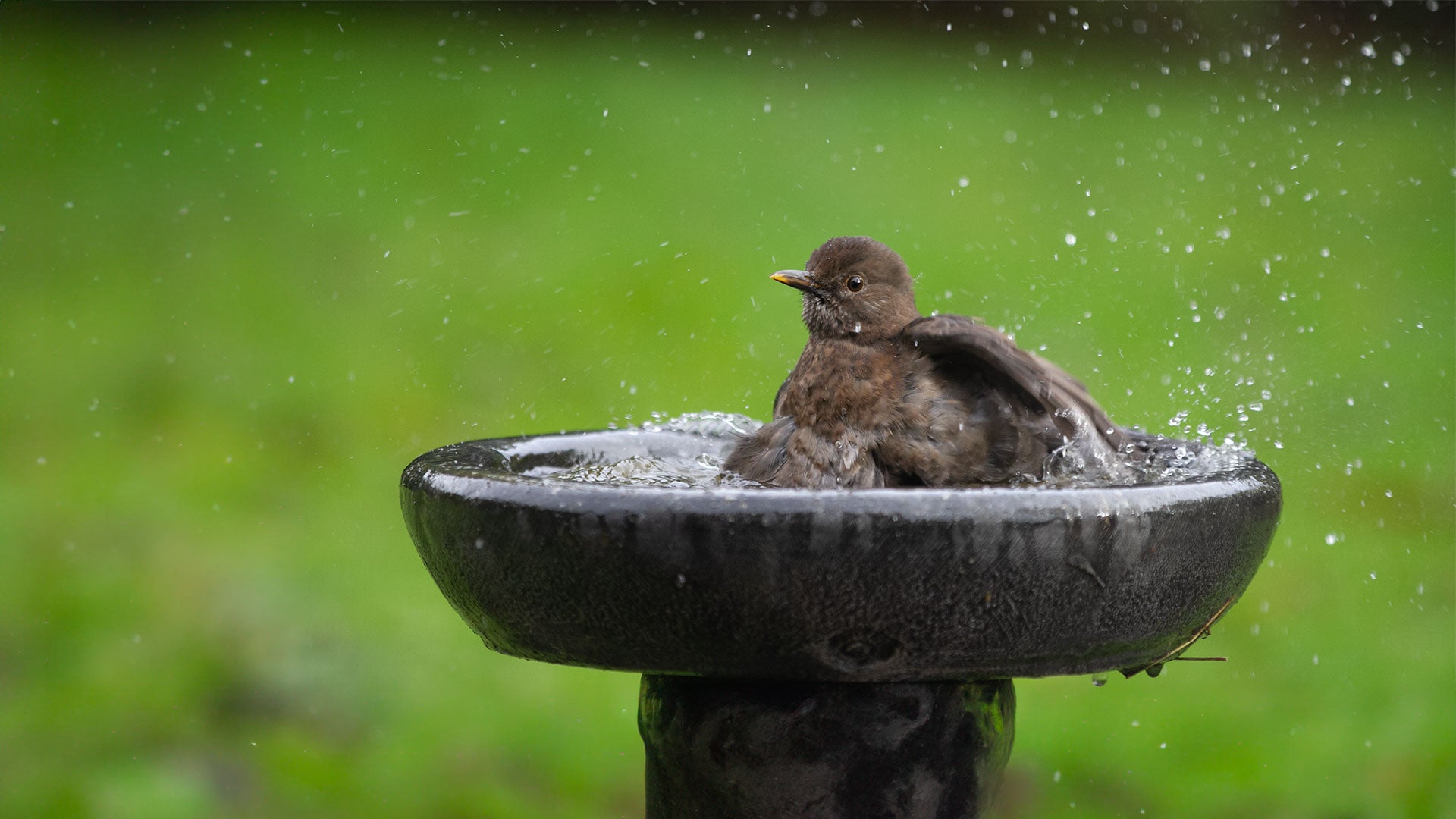
A reliable source of clean water can be just as valuable as food. That might be a simple dish on the ground, a traditional bird bath or, if you're lucky enough to have one, a pond. What matters is that birds can drink and bathe safely and that the water is kept clean, fresh and reliable.
This is something I think we sometimes overlook. We can become focused on what goes into a feeder while forgetting that birds need water every day, whatever the season. During hot, dry weather it can become particularly important, but even in winter a dependable water source can make a real difference.
Give birds somewhere to live
Food and water will bring birds into a garden, but habitat is what encourages them to stay.
Evergreen shrubs provide valuable cover when deciduous trees have lost their leaves. Dense bushes give smaller birds somewhere to retreat from predators and bad weather, while mature trees provide feeding opportunities, nest sites and shelter. Nest boxes can add further opportunities where natural cavities are scarce, and during certain times of year, appropriate supplements such as calcium can also help birds meet particular nutritional demands.
Think about the garden from a bird's perspective. Where would you hide? Where would you sleep? Where could you escape a sparrowhawk? Where could you raise young safely?
Those questions can be more useful than simply asking which feeder to buy next.
Then grow a garden that feeds itself
Ultimately, the best garden for birds is not one that depends entirely on a bag of bird food.
It is a garden that produces food for itself.
Grow plants that produce berries and seeds. Leave some seedheads standing rather than cutting everything back in autumn. Plant flowers that attract insects and allow some areas to remain a little less tidy. Keep mature shrubs, trees, ivy, fallen leaves and other natural cover where you can.
Think of it as creating three things birds need throughout the year: cover, natural food and the insects that become food.
Then supplementary feeding becomes exactly that: supplementary. It is there to help when natural supplies are limited, rather than replacing the natural food web that makes a garden genuinely valuable to wildlife.
And perhaps that is the biggest lesson from this extraordinary year. Wildlife doesn't live according to a timetable. The weather changes. Food availability changes. Bird behaviour changes. Disease risk changes.
Our approach can change too.
For me, that means continuing to feed birds, but doing it thoughtfully. It means keeping feeders clean, watching the birds, responding when something isn't right and, just as importantly, creating a garden where birds can find food, water, shelter and somewhere to live without relying entirely on me.
That feels like a much more complete way of caring for garden birds.
I still believe feeding them is one of the simplest and most rewarding ways we can connect with wildlife. I also believe we have a responsibility to do it well.
There doesn't have to be a choice between feeding birds and protecting them.
We can do both.
Sean McMenemy
Founder & Owner
Ark Wildlife